

State development plans and policies provide a roadmap for addressing development challenges, improving livelihoods, and expanding economic opportunities. However, their effectiveness depends on how well they are implemented, how public resources are utilized, and whether intended results reach communities.
To strengthen this process, the Foundation for Partnership Initiatives in the Niger Delta (PIND) supported state governments in Abia, Cross River, and Delta to track development plan implementation, verify projects, and assess policy progress through its 2026 State Policy Implementation Tracking and Project Verification exercise.
The initiative focused on three government frameworks: the Abia Long-Term Development Plan (LTDP), the Cross River Growth and Development Strategy (CRGDS), and the Delta State Agricultural Policy (2021–2026). Through document reviews, field verification, and engagement with government stakeholders, the exercise examined implementation progress and generated evidence to support planning, budgeting, and accountability.

Strengthening Accountability in Government Project Delivery
In Abia and Cross River states, the exercise built on PIND’s support for government-led project verification in 2025, which helped validate reported project delivery, identify gaps in implementation records, and strengthen monitoring processes.
The 2026 exercise continued this work by addressing outstanding verification activities and examining selected projects under the two states’ development frameworks.
In Abia, the process involved reviewing project documentation and verifying selected projects and programs under the LTDP. In Cross River, PIND’s Monitoring and Evaluation (M&E) team worked with relevant Ministries, Departments, and Agencies (MDAs) and the State Planning Commission to verify projects under the CRGDS.
The process involved reviewing budget and implementation records, visiting project sites, and engaging relevant stakeholders to assess project status, quality, cost, and beneficiary reach. This provided an opportunity to examine the relationship between reported progress and actual project delivery while identifying gaps requiring government attention.
For communities that depend on public investments in infrastructure, agriculture, and essential development services, effective project monitoring is important to ensuring that resources are directed toward identified priorities and that public investments deliver their intended value.


Assessing Agricultural Policy Implementation in Delta State
In Delta State, PIND supported an assessment of the implementation of the Agricultural Policy (2021–2026) as the policy cycle approached its conclusion.
Agriculture remains an important source of livelihoods and economic activity across the Niger Delta. Assessing the implementation of the state’s agricultural policy therefore provides an opportunity to examine progress toward its objectives and identify areas requiring further attention.
The assessment reviewed progress against existing policy targets and monitoring indicators, highlighting the importance of effective coordination, resource allocation, and implementation in advancing agricultural development.
The exercise also provided an evidence base to support government stakeholders in evaluating the current policy cycle and informing priorities for the next phase. This is particularly relevant to farmers, agribusinesses, and other actors whose livelihoods depend on the performance of the agricultural sector.
Strengthening Government Capacity for Results Tracking
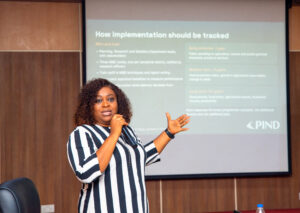
Beyond project verification and policy assessment, the initiative also focused on strengthening the capacity of MDAs to monitor implementation, collect evidence, and report development results.
Through practical engagement on verification, documentation, and reporting, PIND supported government officials in improving the processes used to track progress against established development targets.
Stronger monitoring systems can help government institutions identify implementation challenges, improve the quality of information available for decision-making, and strengthen accountability in the use of public resources. They also provide a foundation for sustaining development tracking beyond individual projects and policy cycles.


Translating Evidence into Development Decisions
The exercise is expected to produce project verification reports for Abia and Cross River, an end-of-cycle tracking report on Delta State’s Agricultural Policy, and a cross-state synthesis of findings and recommendations.
These outputs will provide government stakeholders with evidence of implementation progress, outstanding gaps, and areas requiring further action. They will also inform PIND’s policy advocacy and continued engagement with state institutions on development planning and implementation.
For the Niger Delta, effective development tracking is essential to ensuring that government commitments translate into tangible progress. By supporting state institutions to examine project delivery, assess policy implementation, and strengthen results monitoring, PIND is contributing to more accountable public investment and better-informed development decisions that respond to the needs of communities.