

PIND 2022 Q2 PROGRESS REPORT
April – June 2022
This report highlights the achievements of PIND’s program interventions in the Niger Delta from April – June 2022 (Quarter 2, 2022), and provides relevant information about program management, lessons learned, and plans for the next quarter. The report demonstrates how PIND is driving change to ensure broad-based economic growth in the Niger Delta. PIND’s activities are designed to promote and sustain a culture of learning and adaptation, to build a process where evidence plays a significant role in determining policy direction and interventions in economic development, peace building, advocacy, and capacity building of both government institutions and civil society in the Niger Delta.
Equitable increase in employment and incomes
Reducing Poverty by Overcoming Market Failures
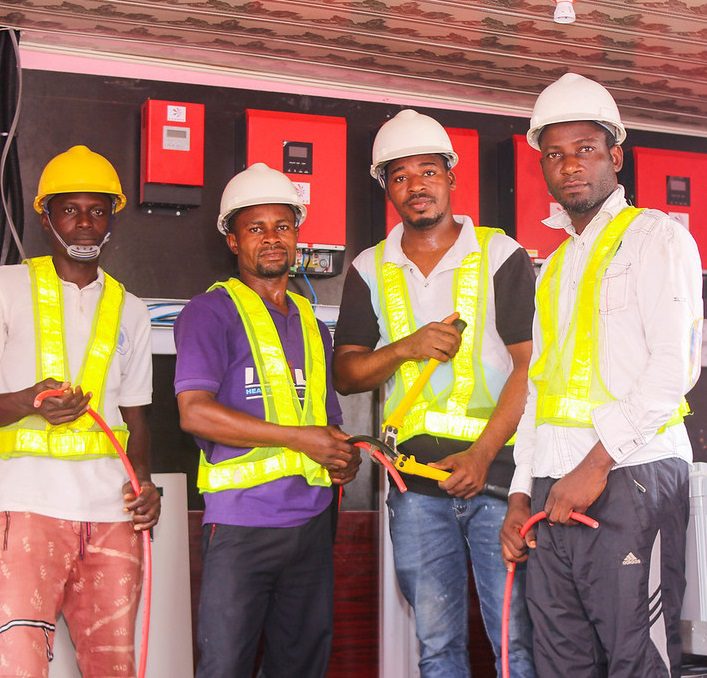
Powering Coastal Rural Communities
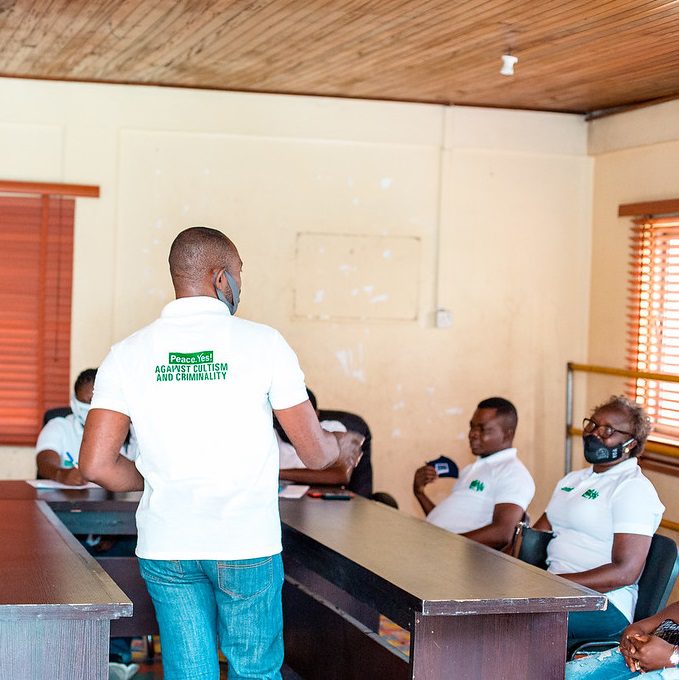
Mitigating Conflicts by Implementing Interventions
SUMMARY OF PROGRESS
Market Systems Development
Market Systems Development: With PIND’s market development projects continuing to demonstrate progress towards widespread change, 15,190 farmers and agricultural entrepreneurs (42% of them being women) were reached with information and knowledge on best practices and efficient technologies in the crop and non-crops sectors.
PIND incentivized MSMEs and participating farmers to invest ₦1.8 billion to implement good agricultural practices, technological innovations, purchase inputs and undertake other capital expenditures. A total of ₦2.56 billion has been leveraged so far in 2022 (₦334.8 million: Equity and ₦2.2 billion: debt).
Access to Energy
PIND continued to play a significant role in driving the market for low–carbon, low–cost solutions that offer high-quality energy access to coastal communities. In Q2, 2022, a PIND-supported partner, Vectis Business Solutions deployed a community solar refrigeration hub to Koluama 2 community in Bayelsa State, to provide commercial refrigeration services to the cooperative members and the wider community. As a result, 250 fisherfolks in Koluama 2 community, and members of the neighboring Olobia community now have access to commercial solar refrigeration services. Another partner, A4&T, invested in the installation of 100 solar home systems (SHS) to serve 100 households in Tsekelewu community, Delta State. Cumulatively, 480 businesses and 750 household have been given access to electricity goods and services, so far in 2022.
Support to GMoU Communities
In the GMoU communities PIND continued its support to demonstration activities of the usefulness of chorkor ovens. Demonstrations were done in Ode-Ugborodo (Delta state) and Bilabiri 1 (Bayelsa state), leading to the adoption of 15 chorkor ovens in these communities, and a total of 35 chorkor ovens so far in 2022. In addition, PIND facilitated capacity-building sessions for fisher folks in Ogidigben (Delta state) Training areas included: safety measures for their fishing activities, appropriate use and maintenance of their fishing gears, and protection of breeding sites for sustainable fishing activities. PIND also facilitated the linkage between Sterling Bank and the Ugborodo fishing association to access finance for upgrade of their fishing gears. Additionally, PIND worked with local service providers to identify equipment dealers for linkage with fisher folks. Consequently, 10 fisher folks from Ogidigben and Gbagira (Ondo state) have adopted higher capacity outboard engines and fishing gears for their fishing businesses.
Youth Employment Pathways
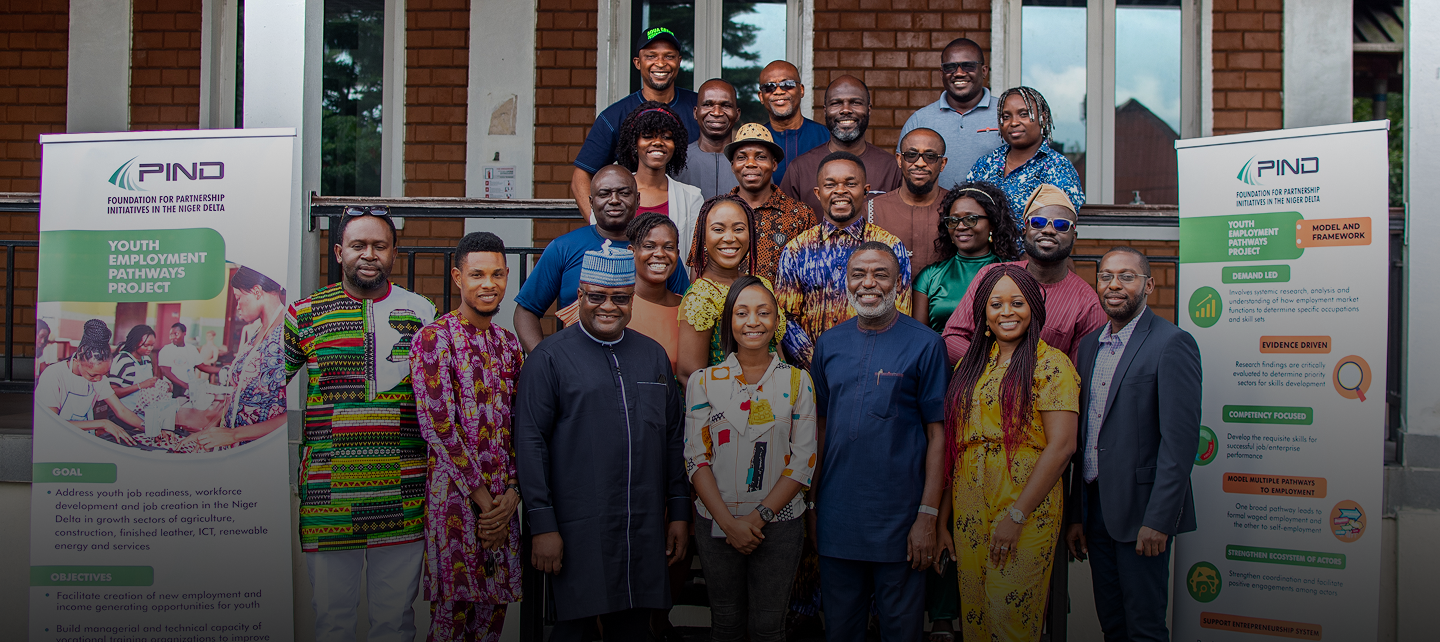
With first phase of the DYEP project over, PIND scaled the YEP model into other states. 991 youths (42% female and 2% PWDs) have been enrolled in the Youth Employment Pathways program in Abia, Akwa Ibom and Rivers States, for the Niger Delta Youth Employment Pathways (NDYEP) scale-up. The youths were enrolled to build technical skills (with embedded soft skills training, for workplace preparedness) in four areas: Agriculture (Aquaculture) in Rivers and Akwa Ibom states, ICT, and building construction in all 3 states; and finished leather in Abia state only. In Delta state, PIND’s collaboration with the Delta State Ministry of Science and Technology was sustained with the ministry taking on some of the DYEP trainees as interns, during the reporting period.
Peace Building
PIND produced 15 conflict reports including 13 weekly conflict briefs and a special policy brief on peace and security impact of illegal artisanal oil refining in the Niger Delta, to create situational awareness, update stakeholders and catalyze response actions, this quarter. Also, PIND assisted 136 peace actors to constructively resolve emerging conflicts in various communities in the Niger Delta. This led to 13 quality actions1 being taken to mitigate conflict in different locations across the region.
Advocacy
In addition, PIND continued its work to ensure access to arable land in the Niger Delta. PIND influenced the establishment of an Arable Land Committee in Delta State. In Edo State, following extensive engagements carried out in the first quarter of the year, PIND secured executive consent of the Edo State governor on the propositions of the arable land committee for Edo State. Also, PIND continued efforts to position itself as a resource organization for the implementation of the Petroleum Industry Act (PIA), by pitching its PIA offerings to Heritage Energy Operational Services Limited (HEOSL) and Ford Foundation, with whom PIND plans to work with to educate host communities on the PIA and their role in the establishment of the HCDT/stewardship of the process.
Business Development
In line with its effort to diversify and expand its funding base, PIND continued engagements with potential partners to explore new opportunities across its program areas. PIND submitted two proposals to energy companies to support the implementation of their Host Communities Development Trusts (HCDT), in line with the PIA. Another proposal was submitted for a $21Million United States Department for Agriculture (USDA) Grant for a cocoa project. In addition, PIND held its first Business Development and Sustainability (BDS) Sub-Committee and board committee meetings.
Communications
By amplifying PIND’s communications this quarter, 2,296,793 people gained new or increased awareness about PIND, through its various platforms: newsletters, social media, website, email inquiries, forums and traditional mainstream media. Also, PIND garnered 39 positive media mentions of its work and activities
and attracted 30 public endorsements from stakeholders who interacted with its content on the website,
newsletters, and social media posts during the same period.
ECONOMIC DEVELOPMENT
In Q2 2021, the Market Systems Development (MSD) Project continued its work with service providers and other key market actors (fabricators, agricultural-input and equipment companies, farmers’ associations, financial institutions, etc.) to improve the performance of farmers to achieve the following objectives:
– Expand the training in best agronomic and business practices to more farmers and enterprises.
– Introduce new efficient technologies and expand the demonstration and adoption of the existing ones.
– Improve farmers’ access to quality seeds and support more enterprises to address market and funding
– Collaborate with the Peacebuilding team to finalize the design of viable interventions in the Chevron GMoU communities to address opportunities for improved livelihoods; and
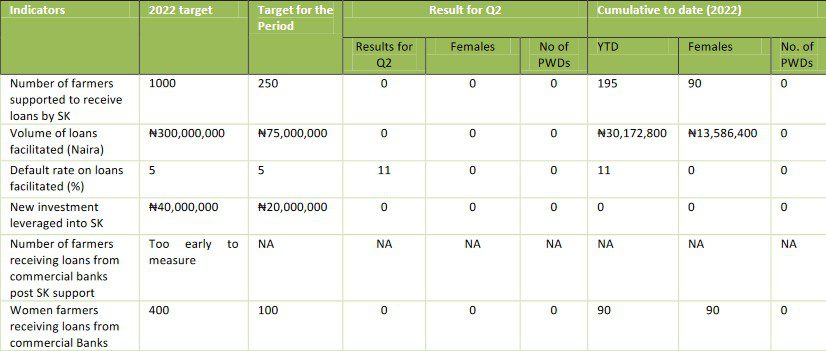
– Implement interventions to improve access to finance for smallholder farmers through Sombreiro Kapital.
As a result, 15,190 new farmers and enterprises were reached directly with information and knowledge on best practices and efficient technologies, representing a 95.8% performance against the quarter’s target of 15,849. Also, within the quarter, the net funds leveraged by farmers/MSMEs adopting improved technologies on their farms6, was ₦1.8billion, making a total of ₦2.56 billion leveraged so far in 2022 – (total loans by MSMEs was ₦2.2billion).
KEY ACHIEVEMENTS: AQUACULTURE
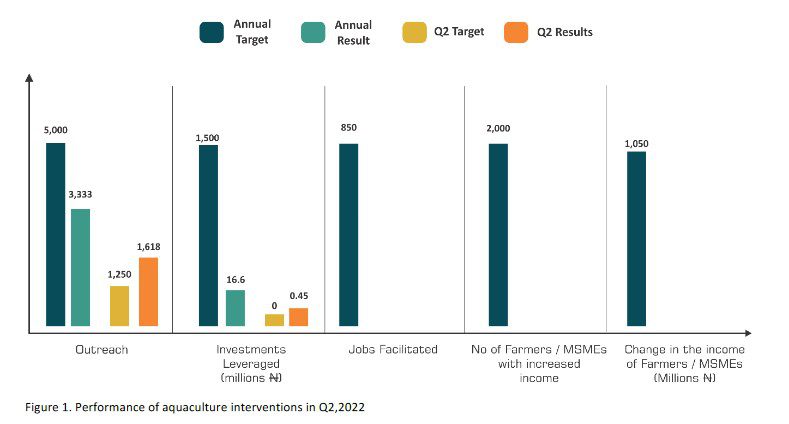
During review period and ahead of the planned close out activities scheduled for Q3, PIND deepened its work with the network of aquaculture service providers to further create awareness on the use of quality inputs and to build the capacity of fish farmers and processors, to access funds for equipment and input purchase, particularly in the GMOU communities. PIND also continued its support to selected hatchery operators to produce and promote quality fish seeds for farmers, in addition to overseeing and tracking the expansion of the training on good pond management and business practices to more farmers and processors, through service providers and input companies in the region. Consequently, PIND reached 1,618 new farmers/processors (756 females).
Also within the quarter, farmers and processors invested ₦450,000 on 15 chorkor ovens adopted in Ugborodo (Delta State) and Bilabiri 1 (Bayelsa State) to serve 138 fish processors.
In line with the Board’s decision to end PIND’s active intervention in the sector, PIND will implement a series of close-out activities to exit the sector in Q3.
[dt_button link=”https://pindfoundation.org/project/aquaculture-value-chain/” target_blank=”true” button_alignment=”default” animation=”fadeIn” size=”medium” style=”link” text_color_style=”context” text_hover_color_style=”accent” icon=”fa fa-chevron-circle-right” icon_align=”left”]Learn more [/dt_button][/dt_teaser]
KEY ACHIEVEMENTS: CASSAVA
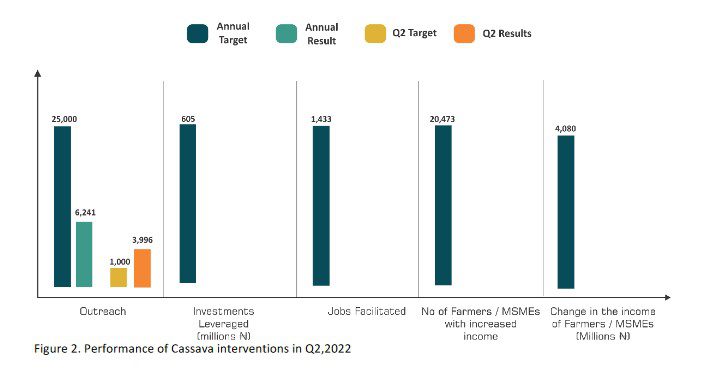
This quarter, PIND continued to expand its activities on productivity improvement, working with new and existing partners across the region, by providing support to partners to strengthen relationships and linkages with farmers to ensure access to agricultural information, and quality inputs including stems, fertilizer, and CPPs required for their production. These partners conducted training programs and established demonstration plots on good agronomic practices across the region, reaching 3,996 (2,446 females) direct farmers this quarter, and 6,241 farmers so far in 2022.
Also, within the reporting period, PIND reviewed its strategy to expand its access to seeds intervention, to establish a more viable commercial Cassava seed system in the region, in collaboration with BASICS II; facilitated the establishment of a 33-hectare cassava out-grower farm in Imo State with Dufill Prima food (off-taker), in collaboration with Sombreiro Kapital and Sterling Bank Ltd.
[dt_button link=”https://pindfoundation.org/project/cassava-value-chain/” target_blank=”true” button_alignment=”default” animation=”fadeIn” size=”medium” style=”link” text_color_style=”context” text_hover_color_style=”accent” icon=”fa fa-chevron-circle-right” icon_align=”left”]Learn more [/dt_button][/dt_teaser]
KEY ACHIEVEMENTS: COCOA
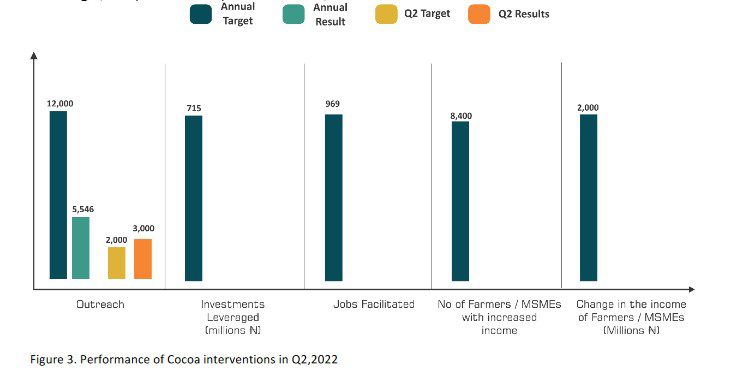
In 2022, PIND plans to support market actors to reach an additional 12,000 farmers with information on good practices, quality agro-inputs, and efficient technologies in the cocoa producing states.
In Q2, 2022, PIND supported export companies, cooperative groups, and Farm Service Providers to organize training programs and demonstration activities to reach new farmers. Eight Farm Service Providers (FSPs), one Nursery Operator, two input companies, and one off-taker, expanded GAP activities to more farmers in Abia, Delta, Edo, and Ondo States reaching 3,000 (788 females) farmers and 5,546 farmers so far in 2022.
[dt_button link=”https://pindfoundation.org/project/cocoa-value-chain/” target_blank=”true” button_alignment=”default” animation=”fadeIn” size=”medium” style=”link” text_color_style=”context” text_hover_color_style=”accent” icon=”fa fa-chevron-circle-right” icon_align=”left”]Learn more [/dt_button][/dt_teaser]
KEY ACHIEVEMENTS: PALM OIL
[dt_button link=”https://pindfoundation.org/project/palm-oil-value-chain/” target_blank=”true” button_alignment=”default” animation=”fadeIn” size=”medium” style=”link” text_color_style=”context” text_hover_color_style=”accent” icon=”fa fa-chevron-circle-right” icon_align=”left”]Learn more [/dt_button][/dt_teaser]
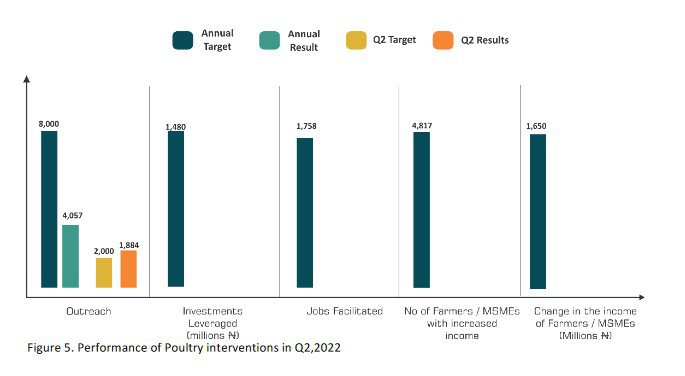
KEY ACHIEVEMENTS: POULTRY
[dt_button link=”https://pindfoundation.org/project/poultry-value-chain/” target_blank=”true” button_alignment=”default” animation=”fadeIn” size=”medium” style=”link” text_color_style=”context” text_hover_color_style=”accent” icon=”fa fa-chevron-circle-right” icon_align=”left”]Learn more [/dt_button][/dt_teaser]
KEY ACHIEVEMENTS: MSME DEVELOPMENT & LINKAGES
The project activities are driven by business services providers (BSPs) whose capacities have been strengthened by PIND to enhance the growth of local enterprises. These BSPs work in partnership with financial institutions, large corporate buyers, chambers of commerce, and other public and private stakeholders important to the development of the MSME sector; to organize business linkages and investment forums, as well as to access new market and funding opportunities necessary for MSME development.
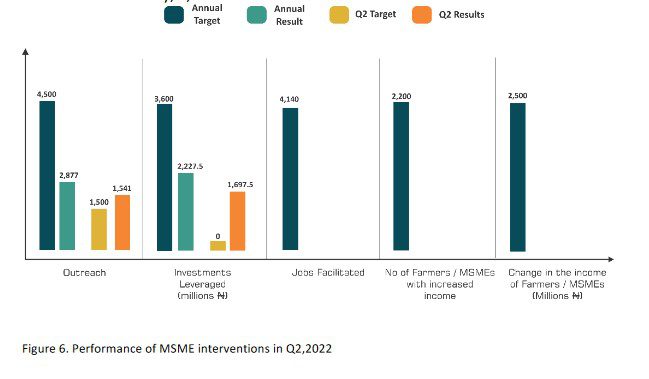
In 2022, PIND plans to work with the business service providers (BSPs) to expand the business performance of 4,500 MSMEs in the region, by improving their technical and business management skills and facilitating linkages to funding and market opportunities necessary for MSME growth and competitiveness.
In Q2, nine BSPs trained and supported 1,541 (664 women owned) MSMEs with business management, business plan development, loan application, and linkages to finance through the CBN Agri-Business/Small and Medium Enterprise Investment Scheme (AGSMEIS) scheme and other MSME-friendly loan schemes, and facilitated a total of ₦1.697 billion in loans. Cumulatively, 2,877 MSMEs have been reached so far in 2022.
[dt_button link=”https://pindfoundation.org/project/market-systems-development/” target_blank=”true” button_alignment=”default” animation=”fadeIn” size=”medium” style=”link” text_color_style=”context” text_hover_color_style=”accent” icon=”fa fa-chevron-circle-right” icon_align=”left”]Learn more [/dt_button][/dt_teaser]
- Aquaculture
-
KEY ACHIEVEMENTS: AQUACULTURE
During review period and ahead of the planned close out activities scheduled for Q3, PIND deepened its work with the network of aquaculture service providers to further create awareness on the use of quality inputs and to build the capacity of fish farmers and processors, to access funds for equipment and input purchase, particularly in the GMOU communities. PIND also continued its support to selected hatchery operators to produce and promote quality fish seeds for farmers, in addition to overseeing and tracking the expansion of the training on good pond management and business practices to more farmers and processors, through service providers and input companies in the region. Consequently, PIND reached 1,618 new farmers/processors (756 females).
Also within the quarter, farmers and processors invested ₦450,000 on 15 chorkor ovens adopted in Ugborodo (Delta State) and Bilabiri 1 (Bayelsa State) to serve 138 fish processors.
In line with the Board’s decision to end PIND’s active intervention in the sector, PIND will implement a series of close-out activities to exit the sector in Q3.
[dt_teaser lightbox=”true” style=”2″ background=”fancy” animation=”zoomIn”]
[dt_button link=”https://pindfoundation.org/project/aquaculture-value-chain/” target_blank=”true” button_alignment=”default” animation=”fadeIn” size=”medium” style=”link” text_color_style=”context” text_hover_color_style=”accent” icon=”fa fa-chevron-circle-right” icon_align=”left”]Learn more [/dt_button][/dt_teaser]
- Cassava
-
KEY ACHIEVEMENTS: CASSAVA
This quarter, PIND continued to expand its activities on productivity improvement, working with new and existing partners across the region, by providing support to partners to strengthen relationships and linkages with farmers to ensure access to agricultural information, and quality inputs including stems, fertilizer, and CPPs required for their production. These partners conducted training programs and established demonstration plots on good agronomic practices across the region, reaching 3,996 (2,446 females) direct farmers this quarter, and 6,241 farmers so far in 2022.
Also, within the reporting period, PIND reviewed its strategy to expand its access to seeds intervention, to establish a more viable commercial Cassava seed system in the region, in collaboration with BASICS II; facilitated the establishment of a 33-hectare cassava out-grower farm in Imo State with Dufill Prima food (off-taker), in collaboration with Sombreiro Kapital and Sterling Bank Ltd.
[dt_teaser lightbox=”true” style=”2″ background=”fancy”]
[dt_button link=”https://pindfoundation.org/project/cassava-value-chain/” target_blank=”true” button_alignment=”default” animation=”fadeIn” size=”medium” style=”link” text_color_style=”context” text_hover_color_style=”accent” icon=”fa fa-chevron-circle-right” icon_align=”left”]Learn more [/dt_button][/dt_teaser] - Cocoa
-
KEY ACHIEVEMENTS: COCOA
In 2022, PIND plans to support market actors to reach an additional 12,000 farmers with information on good practices, quality agro-inputs, and efficient technologies in the cocoa producing states.
In Q2, 2022, PIND supported export companies, cooperative groups, and Farm Service Providers to organize training programs and demonstration activities to reach new farmers. Eight Farm Service Providers (FSPs), one Nursery Operator, two input companies, and one off-taker, expanded GAP activities to more farmers in Abia, Delta, Edo, and Ondo States reaching 3,000 (788 females) farmers and 5,546 farmers so far in 2022.
[dt_teaser lightbox=”true” style=”2″ background=”fancy” animation=”zoomIn”][dt_button link=”https://pindfoundation.org/project/cocoa-value-chain/” target_blank=”true” button_alignment=”default” animation=”fadeIn” size=”medium” style=”link” text_color_style=”context” text_hover_color_style=”accent” icon=”fa fa-chevron-circle-right” icon_align=”left”]Learn more [/dt_button][/dt_teaser]
- Palm Oil
-
KEY ACHIEVEMENTS: PALM OIL
[dt_teaser lightbox=”true” style=”2″ background=”fancy” animation=”zoomIn”]
[dt_button link=”https://pindfoundation.org/project/palm-oil-value-chain/” target_blank=”true” button_alignment=”default” animation=”fadeIn” size=”medium” style=”link” text_color_style=”context” text_hover_color_style=”accent” icon=”fa fa-chevron-circle-right” icon_align=”left”]Learn more [/dt_button][/dt_teaser] - Poultry
-
KEY ACHIEVEMENTS: POULTRY
[dt_teaser lightbox=”true” style=”2″ background=”fancy” animation=”zoomIn”]
[dt_button link=”https://pindfoundation.org/project/poultry-value-chain/” target_blank=”true” button_alignment=”default” animation=”fadeIn” size=”medium” style=”link” text_color_style=”context” text_hover_color_style=”accent” icon=”fa fa-chevron-circle-right” icon_align=”left”]Learn more [/dt_button][/dt_teaser] - MSMEs
-
KEY ACHIEVEMENTS: MSME DEVELOPMENT & LINKAGES
The project activities are driven by business services providers (BSPs) whose capacities have been strengthened by PIND to enhance the growth of local enterprises. These BSPs work in partnership with financial institutions, large corporate buyers, chambers of commerce, and other public and private stakeholders important to the development of the MSME sector; to organize business linkages and investment forums, as well as to access new market and funding opportunities necessary for MSME development.
In 2022, PIND plans to work with the business service providers (BSPs) to expand the business performance of 4,500 MSMEs in the region, by improving their technical and business management skills and facilitating linkages to funding and market opportunities necessary for MSME growth and competitiveness.
In Q2, nine BSPs trained and supported 1,541 (664 women owned) MSMEs with business management, business plan development, loan application, and linkages to finance through the CBN Agri-Business/Small and Medium Enterprise Investment Scheme (AGSMEIS) scheme and other MSME-friendly loan schemes, and facilitated a total of ₦1.697 billion in loans. Cumulatively, 2,877 MSMEs have been reached so far in 2022.
[dt_teaser lightbox=”true” style=”2″ background=”fancy” animation=”zoomIn”]
[dt_button link=”https://pindfoundation.org/project/market-systems-development/” target_blank=”true” button_alignment=”default” animation=”fadeIn” size=”medium” style=”link” text_color_style=”context” text_hover_color_style=”accent” icon=”fa fa-chevron-circle-right” icon_align=”left”]Learn more [/dt_button][/dt_teaser]
YEP SCALE-UP IN ABIA, AKWA IBOM & RIVERS STATES
In 2018; with funding from Ford Foundation, PIND implemented the Niger Delta Youth Employment Pathways (NDYEP) Pilot Project in Abia, Akwa Ibom and Rivers States. The pilot provided vocational skills training to 4,355 youths in emerging growth sectors of Agriculture, Information and Communication Technology (ICT) and Building Construction and supported linkages of these trainees to employment opportunities. With the completion of the Ford Foundation funded pilot phase of NDYEP, PIND, with its own funding, has commenced its scale-up in the pilot states of Abia, Akwa Ibom and Rivers, in addition to ongoing activities in Delta State.
Out of 2,422 applicants, 991 youths were enrolled in the NDYEP scale up project across the three states, within the reporting period. These youths were enrolled to build skills in four sectors: Agriculture (Rivers and Akwa Ibom States), ICT, building construction, and finished leather (Abia State only). The project is working with 11 implementing partners (involved in the NDYEP pilot phase) and private technical and vocational education and training (TVET) institutions to provide technical vocational skills training, whilst mainstreaming soft skills and entrepreneurship, in the curriculum.
The coastline rural communities in the Niger Delta region of Nigeria suffer poor rural electrification, with many of the communities not having access to regular electricity supply to power basic economic assets and household needs, leading to reduced economic activities. Expectations for connection to the National grid anytime soon are unlikely due to high-cost implications and the difficult terrains. Since 2018, PIND has been addressing this gap through alternative and affordable off-grid solutions, capable of targeting not only basic energy needs (i.e lighting and cooking energy), but also productive use of energy at both household and rural enterprise levels (such as used in barber shops and beauty salons).
[/dt_teaser]
Outreach
PIND’s Access to energy program had an outreach of 970 in Q2 2022. This are 850 persons across 250 businesses and 100 households now enjoying access to electricity goods and services, 110 persons who participated in PIND supported demonstrations, and 10 persons who received training as new village level energy stewards.
Matching Unserved Coastal Communities with Potential Power Project Developers
As part of the technical assistance and support provided to new businesses and power providers in Q2 2022, PIND facilitated community energy assessments and sensitization visits to three riverine communities in Delta and Edo states.
This was in a bid to match 3 solar power developers – ETIN power Limited, Oghosa Limited and Contained Energy Limited – who have interests in providing commercial solar electricity in the coastal areas, with viable communities. The visit engaged community leadership across Adagbarassa (Delta State), Ofunama (Edo State) and Ajakurama (Edo State) communities and completed some preliminary assessment on viability for commercial mini grids.
Solar Refrigeration for Coastal Communities
Earlier in the year, a needs assessment of the fishing communities around the coastal parts of the Niger Delta, without access to electricity, was completed with a view to supporting access to energy projects in hard-to-reach coastal communities, for value added electricity services in one of such communities. This led to the identification of Koluama 2 in Brass Local Government Area of Bayelsa State, as fit for the project, due to the demand for electricity to power cold storage equipment and the potential for commercialization.
Collaborating with the KOTEF fishing cooperative as the anchor offtaker for the refrigeration hub services, PIND carried out a series of engagements and sensitization activities on the productive use of renewable energy cold storage services, in Q1 2022. The engagements buttressed the benefit of employing pro poor business models to prevent post-harvest losses for fisher folks, using cost-effective pay-per-service method. In Q2 2022, Vectis Business Solutions limited deployed a community solar refrigeration hub to Koluama 2 community, to provide commercial refrigeration services to the cooperative members as well as the wider community. Through this intervention, 250 fisherfolks in Koluama 2 community, and members of the neighboring Olobia community now have access to commercial solar refrigeration services.
The project also trained 5 community energy stewards as part of the support services towards establishing a sustainable operations and maintenance regime, while two of the trainees were employed as full-time hub workers.
Closing the Electricity Supply Gap in Underserved Communities with Solar-Home-Systems
Solar Home Systems (SHS) are a range of quick-deployment access to energy technologies, that bridge the gap between productive use and welfare needs – a typical scenario common to the riverine areas. It extends the power availability
period (hours) at a reduced cost and impact to the environment and has therefore become an increasingly popular solution for many off-grid communities.In Q2 2022, PIND facilitated a Business to Consumer B2C town hall to support the introduction of other access to energy models that can support basic welfare needs in some coastal communities. To this end, a SHS demonstration was carried out in Tsekelewu community (Delta State) to explore the supply gaps from their community generator systems.
For coastal communities like Tsekelewu with communal generating sets, the SHS offers some resilience against the instability of the local generator grid. On the one hand, the SHS is able to plug the demand gap for electricity by powering tier 1 and 2 systems of energy which are essentially phones, light bulbs and fans. On the other hand, it has the potential of weaning the households from non-essential fossil fuel electricity use and consequently a reduction on their household spend and demand for electricity from the diesel generators.
Through this activity, PIND leveraged ₦6M through A4&T’s investment in 100 SHS to be installed across an initial 100 households in Tsekelewu community. In addition, PIND’s community engagement efforts, training of community energy stewards and technology demonstration events all contributed towards derisking the project for A4&T who invested in technology that will provide access to electricity, through Pay-as-you-go services to subscribing households.
63 persons attended the technology demonstration at the Tsekelewu community hall, while another 5 members of the community were trained and retained as distribution service agents to scale the penetration of the SHS in the community and neighboring locations.
PIND and AEAS Interventions in the Niger Delta
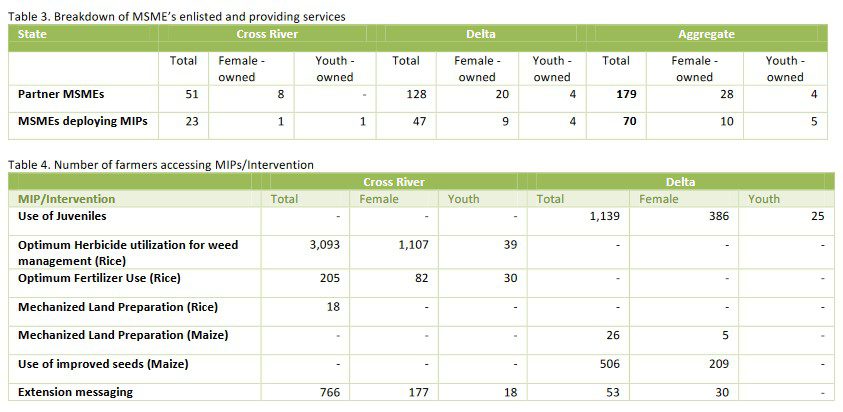
The AEAS project focuses on interventions in Aquaculture, Maize and Rice in Delta and Cross River States. Between April and June 2022, the Extension Activity identified and validated 11 additional MIPs, bringing the total list to 20 MIPs across the five target value chains it is intervening; nine of these MIPS are being promoted in Cross River and Delta State as shown below.
- Aquaculture: Stocking juveniles; Complementary feeding with Maggots and Duckweed
- Maize: Mechanized land preparation, Fall Army Worm control & management
- Rice: Mechanized threshing, Mechanized land prep with small equipment- power tillers (lowland rice)
- Maize & Rice: Use of improved seeds, optimum herbicide utilization for weed management, optimum fertilizer use
Of the 179 MSMEs partnering with the Extension Activity and receiving services to promote private sector extension in Cross River and Delta states, 70 MSMEs commercialized the MIPs this quarter and are providing extensions services to 7,798 small holder farmers (SHFs). Of these, 4 MSMEs conducted demand stimulation and extension messaging campaigns in Cross River state on the use of improved seeds in 11 communities in these 4 LGAs: Akamkpa, Bekwarra, Obanliku, and Ogoja. To further reach farmers in rural communities with extension services and stimulate the adoption of MIPs, 10 MSMEs in Cross River State engaged and trained 80 private Agricultural Extension Agents (AEAs), which include champion farmers and small-scale out-door agricultural input retailers, to serve farmers in Ogoja and Yala LGAs.
PEACEBUILDING
This section highlights key achievements of the Peace Building program in Q2, 2022
PIND continued to undertake interventions in conflict prevention, conflict management and peacebuilding in the Niger Delta region as part of the plan of action aimed at keeping the level of violence as low as possible, particularly in key communities of interest, while also building the social infrastructure and social capital of peace actors across the region for long term sustainable peace. PIND’s peace building strategy recognizes the need for an integrated and comprehensive approach to tackling the complex causes and drivers of conflict; adopting innovative approaches to work on problems of militancy, election violence, gang/cult violence, communal violence, and the cross-cutting issue of Violence Affecting Women and Girls (VAWG).
 [/dt_teaser]