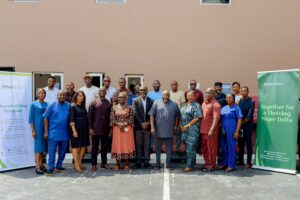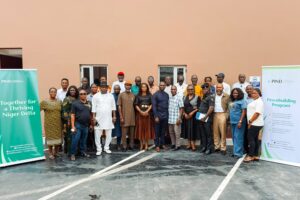

Building peaceful and resilient communities requires more than responding to conflict—it requires strong local institutions that can prevent tensions, manage grievances, and foster dialogue before disputes escalate. Through its Peacebuilding Programme, the Foundation for Partnership Initiatives in the Niger Delta (PIND) is strengthening the capacity of Host Community Development Trusts (HCDTs) to serve as drivers of community resilience and sustainable development.
As part of this effort, PIND conducted a series of capacity-building workshops for Peacebuilding Committees drawn from the Egbema-OPUDIS, Agbonu Ogulagha Ibe, and Warri Kingdom Coastal Host Community Development Trusts in Delta State.
The initiative builds on earlier engagements with the Ugboland HCDT in Ondo State and reflects PIND’s broader strategy of institutionalizing community-led peacebuilding systems across the Niger Delta.


Building Local Capacity for Conflict Prevention
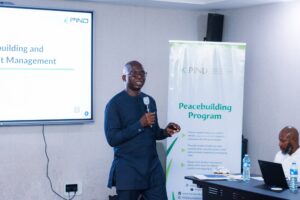
The workshops equipped committee members with practical skills in dialogue facilitation, non-adversarial conflict management, grievance handling, conflict early warning and response, and resilience localization.
Bringing together HCDT representatives, traditional leaders, security agencies, local government officials, women leaders, youth representatives, and other stakeholders, the sessions promoted stronger collaboration and shared responsibility for maintaining peace within host communities.
Participants also explored practical approaches for strengthening coordination between community institutions and security agencies while enhancing stakeholder engagement to address emerging tensions before they escalate.
Speaking during the workshop, PIND’s Peacebuilding Manager, Dr. David Udofia, emphasized that sustainable development depends on the strength of local peace infrastructure. “Peacebuilding cannot be reactive. Communities need systems that anticipate tensions, manage grievances early, and promote dialogue before conflicts escalate. Strengthening local peace structures is essential for building resilience, trust, and long-term development,” he said.
Institutionalizing Community Resilience
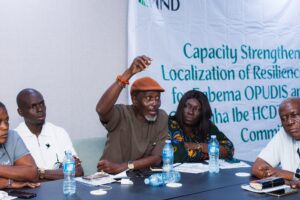
Beyond strengthening individual capacities, the workshops reinforced the mandates of HCDT Peacebuilding Committees as permanent community institutions responsible for promoting peaceful coexistence and supporting sustainable development.
The initiative also advanced the localization of resilience strategies by equipping committees with practical tools to improve mediation, stakeholder engagement, and collaboration across community structures.
As these committees continue to apply their knowledge within their respective communities, they are expected to play an increasingly important role in strengthening local governance, improving conflict prevention mechanisms, and supporting more stable environments for social and economic development.
Investing in Peace for Sustainable Development
PIND’s Phase IV strategy recognizes that peace is fundamental to inclusive economic growth and community resilience. By strengthening local institutions and promoting community ownership of peacebuilding processes, the organization is helping communities develop sustainable systems capable of preventing conflict and managing grievances over the long term.
Through continued collaboration with Host Community Development Trusts and other stakeholders, PIND remains committed to building resilient communities where dialogue, trust, and partnership create the foundation for lasting peace and sustainable development across the Niger Delta.