

PIND Celebrates the Retirement of Executive Director Tunji Idowu: A Legacy of Empowerment, Innovation, and Regional Transformation
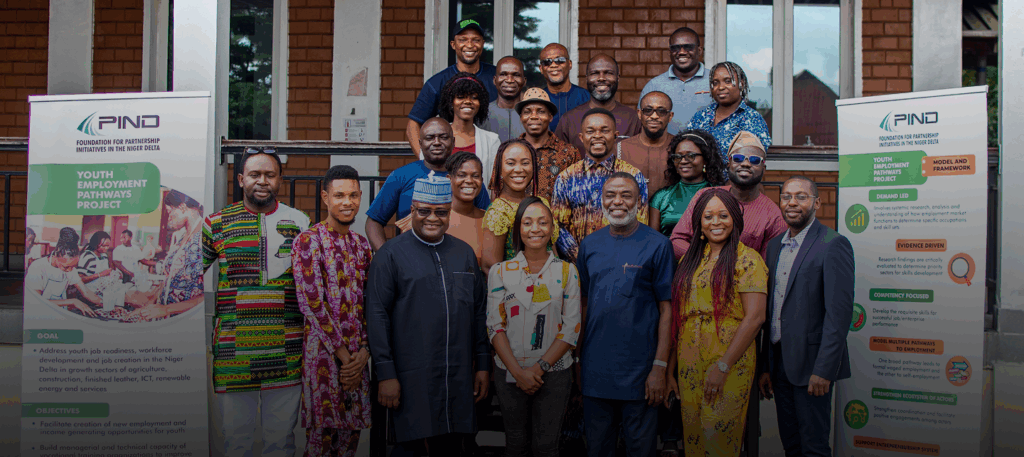
The Foundation for Partnership Initiatives in the Niger Delta (PIND) celebrates the remarkable leadership and legacy of its Executive Director, Mr. Tunji Idowu, who retires after nearly a decade of dedicated service. Since joining PIND as Deputy Executive Director in 2016 and later becoming Executive Director, Mr. Idowu has been instrumental in shaping the organization’s […]
PIND Sponsors Media Awards for Niger Delta Reporting on Development
The Foundation for Partnership Initiatives in the Niger Delta (PIND) is proud to sponsor The PIND Prize for Niger Delta Development Reporting at the Diamond Awards for Media Excellence (DAME). This will be the second time PIND is sponsoring this prize. The PIND Prize rewards solution journalism reports on issues within the Niger Delta that […]
PIND Foundation has been nominated for the MKO Abiola Community Engagement Award
The race to select and celebrate Nigeria’s community development and human rights heroes has intensified as voting commences for the nominees of the 2021 Community and Human Rights (CAHR) Awards, organised by frontline sustainability focussed outfit, CSR-in- Action. CAHR Awards is Nigeria’s first initiative dedicated to celebrating outstanding individuals and organisations that have performed excellently […]
DCED Certifies PIND as an International Market Development Champion
The Foundation for Partnership Initiatives in the Niger Delta (PIND) has been recently certified by the Donor Committee for Enterprise Development (DCED) as an international market development crusader. This is due to its adoption of the international standard procedure as recognized by the DCED in its socio-economic development programs to address various economic challenges in […]
Communique From RSPO Workshop in Benin
PREAMBLE The Round Table on Sustainable Palm Oil (RSPO) certification assures buyers of palm oil products that the standards of production are sustainable. On the international scene, this certification is required for large plantations/processors to supply palm oil products to the big industrial consumers/secondary processors. The large plantations that are RSPO certified can only buy […]
Dr. Dara Akala steps in as PIND Executive Director
Effective on December 1, 2016, Dr. Dara Akala takes over from Sam Daibo as Executive Director of the Foundation for Partnership Initiatives in the Niger Delta (PIND). Dr. Akala has helped to shape the direction of PIND’s various programs and projects over the past five years. He has worked with PIND since 2011 when […]
Towards Self-Sustaining Development in the Niger Delta: Narrating and Showcasing a Re-Imagined Niger Delta
The Foundation for Partnership Initiatives in the Niger Delta (PIND), in collaboration with the Imo State Government and Market Development for the Niger Delta (DAI -MADE) is set to hold the fifth edition of the Niger Delta Development Forum (NDDF) in Owerri, Imo State, from October 19-20, 2016 with the theme ‘Towards Self-Sustaining Development in the […]
GIZ, PIND Partner with Federal Government, Development Organizations on National Cassava Summit
Deutsche Gesellschaft fur Internationale Zusammenarbeit (GIZ) and Foundation for Partnership Initiatives in the Niger Delta (PIND) Partners with Federal Government, Development Organizations on National Cassava Summit Theme: Towards a U.S. $5 billion Per Annum Cassava Industry in the Next Five Years Abuja, Nigeria – On September 8th, 2016, GIZ and PIND, in collaboration with […]
CAPABLE Produces 25 Market Development Facilitators and Implementers for the Niger Delta
In October 2015, our capacity building program collaborated with DFID-funded Market Development (MADE) and PROPCOM MAKARFI projects to hold a three-day training at PIND’s Port Harcourt EDC on Adopting Market Development Approach for Development Programming.
GIZ, PIND Partner with Federal Government, Development Organizations on National Cassava Summit
Cassava is a staple food crop throughout the African continent, particularly in Nigeria. Despite being the world’s largest producer of the cassava, Nigeria produces cassava primarily for domestic consumption and does not rank among leading exporting countries.
