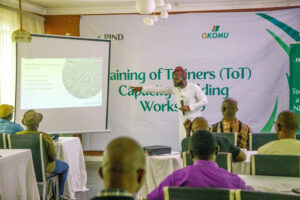
Corporate-community engagement across the Niger Delta is evolving beyond the provision of static infrastructure, which often overlooks the key drivers of long-term economic resilience. In a strategic shift toward human capital development, the Foundation for Partnership Initiatives in the Niger Delta (PIND), in partnership with Okomu Oil Palm Company Plc (OOPC), hosted a specialized Training of Trainers (ToT) Capacity Building workshop in Benin City, Edo State.
Held from February 26–27, 2026, the workshop equipped 20 selected prospective technical service providers drawn from Okomu’s neighbouring communities to function as professional Technical Service Providers (TSPs). Utilizing PIND’s Market Systems Development (MSD) approach, the initiative is designed to strengthen these community representatives with the skills needed to deliver sustainable technical and business advisory services that drive agricultural productivity and long-term economic growth within their communities.

Building a Local Knowledge Hub
The two-day intensive program moved beyond theoretical training, addressing the practical challenges of agriculture in the Niger Delta. By equipping TSPs with facilitation skills for adult learning and advanced technical knowledge, PIND ensures expertise is transferred directly from the classroom to the field. This model empowers local actors to view themselves as commercial agricultural technical service providers capable of offering high-quality advisory services to smallholder farmers in their communities.
Representing PIND’s Market Systems Development Manager, Mr. Tuoyo Omagbitse Blessing, Senior Market Systems Development Advisor, noted that the goal of the workshop is to strengthen the prospective service providers to enable them to provide agricultural technical services to farmers in their respective communities, and across the Niger Delta at large, leading to an increase in productivity and income for smallholder farmers.
A Multidimensional Approach to Agriculture
The workshop focused on four priority value chains critical to the region’s economic landscape: Oil Palm, Cassava, Cocoa, and Rubber. Facilitated by Master Service Providers, including TA Commodities, Agronadol Limited, and Citron Spring, the curriculum integrated:
- Technical Excellence: Land preparation, seed handling, and disease control using climate-smart practices to ensure high-yield, resilient harvests.
- Business Sustainability: Strategic guidance on pricing and service packaging to transition TSPs from ad-hoc support to profit-driven enterprises.
Market Integration: Strategies to bridge the gap between rural fields and the formal economy by connecting farmers with reliable input suppliers, financial institutions, and large-scale aggregators


Why This Matters: Impact at Scale
This partnership is about more than just a two-day training; it is a strategic investment in agricultural transformation. By professionalizing local service delivery, the PIND-Okomu collaboration is designed to:
- Reach 3,000+ Farmers: The 20 trained TSPs will cascade their knowledge to thousands of rural households.
- Enhance Resilience: Farmers will gain the confidence to adopt climate-smart technologies that protect against environmental volatility.
- Ensure Sustainability: Locally embedded service models mean that support for farmers continues long after the project cycle concludes.
Looking Ahead
As the initiatives progress, the selected technical service providers will participate in intense on-site mentorship and field demonstrations to refine their technical expertise. By sharpening these critical skills, PIND ensures that localized, climate-smart agricultural models are effectively demonstrated and adopted across vulnerable regions.
Through sustained collaboration, PIND and Okomu are proving that when corporate social responsibility aligns with market-driven expertise, the result is ensuring a more resilient and productive agricultural sector for Okomu’s neighbouring communities and the region at large. By equipping these local actors with advanced technical and business skills, PIND is ensuring that agricultural expertise is not just imported, but locally embedded and commercially viable.