
Across the Niger Delta, recurring tensions continue to disrupt livelihoods, local markets, and agricultural productivity, undermining both community safety and the broader region’s economy. These challenges highlight the urgent need for structured, community-led systems that can prevent escalation.
Recognising that sustainable development depends on peaceful and resilient communities, the Foundation for Partnership Initiatives in the Niger Delta (PIND), in a strategic partnership with Okomu Oil Palm Company Plc (OOPC), convened a targeted intervention to strengthen local systems for conflict prevention.
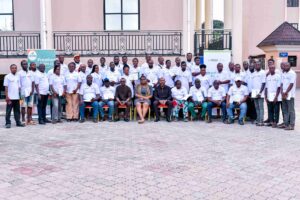
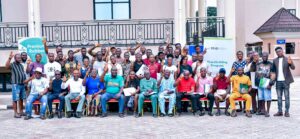
Held from March 31 to April 1, 2026, PIND and OOPC hosted an Early Warning and Early Response (EWER) workshop in Edo State, bringing together 54 representatives from 18 Okomu-neighbouring communities. The training equipped participants to identify, verify, and report early signs of conflict as community-based Peace Monitors, strengthening local capacity for real-time risk detection and information sharing while laying the foundation for a more coordinated peace architecture.


From Awareness to Action: Building Local Peace Monitors
At the heart of the workshop was a simple but powerful shift: equipping community members with the tools to detect and report early signs of conflict in real time.
Participants learnt to distinguish between rumours and verified information, document incidents responsibly, and use PIND’s SMS-based EWER platform to report emerging risks ranging from land disputes to inflammatory messaging and youth mobilisation.
Managed by PIND’s Integrated Peace and Development Unit (IPDU), the EWER system provides a structured channel for collecting and analysing real-time data, enabling faster, more coordinated responses. More importantly, it shifts communities from reactive crisis management to proactive, data-driven prevention.
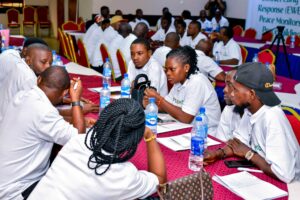

By the end of the training, the 54 Peace Monitors had become active contributors to a growing peace infrastructure, serving as the “eyes and ears” of their communities.
Impact at Scale: What This Means for Communities
This intervention represents a strategic investment in the social infrastructure of the Niger Delta. Its impact extends beyond the training room:
- Stronger early warning systems: Communities are now better equipped to detect and respond to risks before they escalate.
- Inclusive peace structures: Youth and women are actively integrated into peacebuilding efforts, ensuring broader representation in decision-making.
- Improved information flow: Verified, real-time reporting reduces the spread of rumours and misinformation.
- Enhanced stability: A more secure and predictable environment supports the livelihoods of over 50,000 residents who depend on agriculture and local enterprise.


Looking Ahead: Deepening the Peace Architecture
The onboarding of the 54 Peace Monitors is only the first step. In the next phase, 36 members of newly established Integrated Peacebuilding Committees (IPCs) will be strengthened to serve as first-level response structures facilitating dialogue, managing grievances, and coordinating non-violent interventions. Together, the Peace Monitors and IPCs form a coordinated, community-driven peace architecture linking early warning with timely response.
By combining corporate investment with community leadership, PIND and OOPC are demonstrating that sustainable peace is not built through isolated interventions but through systems that empower people, strengthen institutions, and foster collaboration. In Okomu’s neighbouring communities, this approach is already taking shape, one trained monitor, one reported alert, and one resolved conflict at a time.