

NATIONAL CASSAVA SUMMIT
CATALYSING AND SCALING OF PRIVATE SECTOR-LED CASSAVA SEED DEVELOPMENT IN NIGERIA.
Nigeria has embarked on reforms to transform cassava for food security, wealth creation, and economic prosperity. The reforms are encapsulated in the country’s national policy for agricultural development known as the Agricultural Promotion Policy (APP).
The APP prioritizes cassava for export and the domestic market and recognizes the productivity challenge of a largely inefficient input system and farming model.
Consequently, the cassava farming ecosystem is dominated by an aging population of farmers who do not have enough seeds and related support to be successful.
Furthermore, challenges faced by the national agricultural and research systems (NARS) have been relatively severe, particularly around improved varieties of seed or other planting materials. There is also the failure to deliver already proven technologies available on the shelf to farmers’ fields where they are needed.
Addressing these will require better coordination between the extension delivery system, the national agricultural research system, and public and private sector suppliers of agricultural inputs.
Consequent on the above, the Project: Building an Economically Sustainable Integrated Cassava Seed System, phase 2 (BASICS-II), managed by the International Institute of Tropical Agriculture (IITA), Foundation for Partnership Initiatives in the Niger Delta (PIND), National Agricultural Seed Council (NASC), National Root Crops Research Institute (NRCRI), Sahel Consulting, Catholic Relief Services (CRS), and the Alliance for Green Revolution (AGRA), along with other stakeholders of the cassava value chain (private sector, public sector, research, development partners) is organizing a National Cassava Seed Development Summit to catalyze private-sector-led investment in the cassava seed sector.
[bg_collapse view=”button-blue” color=”#F0F7FF” icon=”arrow” expand_text=”VIEW KEY PARTICIPANTS” collapse_text=”Show Less” ]
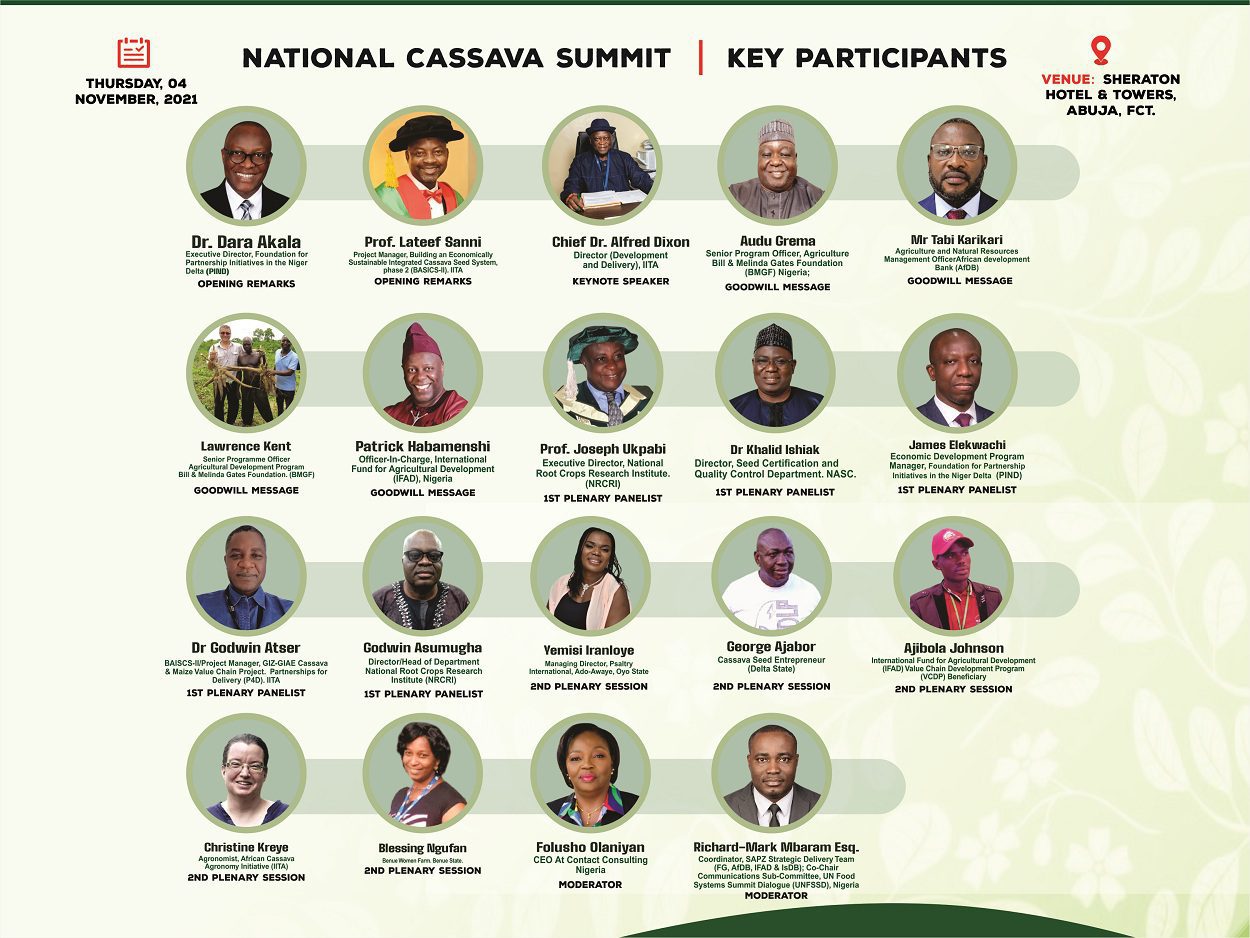 [/bg_collapse]
SUMMIT OBJECTIVES:
- Identify and engage on the policy reforms required to galvanize the cassava seed sector to raise productivity and drive industrial growth projections.
- Promote impactful and economically sustainable seed models.
- Build the capacity of public and market actors and other key stakeholders for effective seed system coordination and competitiveness.
- Unveil opportunities in the cassava seed sector for private capital investment.
[/dt_vc_list]
QUESTIONS:
- A) Seed Quantity: What is the prospect in terms of demand (quantity) for cassava seeds in the next five years? What reforms, technology, and coordination are needed to achieve the volume requirement? What are the existing seed initiatives? How is the seed system responding to industry demand for High Quality Cassava Flour, starch, ethanol, livestock feed, etc? How is the seed system responding to traditional food such as gari, fufu, etc?
- B) Seed Quality: To what extent do the different stakeholders in the value chain meet the quality requirements for improved cassava stems? What reforms, technology, and coordination are needed to improve quality seeds at the various levels—production, transportation, handling, and bulking?
- C) Framework conditions: What is needed in terms of a regulatory/legislative framework to improve the profitability and efficiency of the different cassava seed systems? What should change or remain in terms of agriculture and trade policies and extension services?
- D) Capacity Development: What are the specific capacity needs to overcome to develop the cassava seed value chains? What kind of training is needed—(e.g., Good Agronomic Practices, Digital tools, Six Steps to Cassava Weed Management, Foundation & Commercial seed system production, farmers’ and processors’ group development training, farmer business school training, etc.)?
- E) Finances: What are the specific finances available for various cassava seed models? Are there bank loans for interested investors in seed system production, root farming, processing facilities, marketing hubs, etc?
[/dt_vc_list]

